
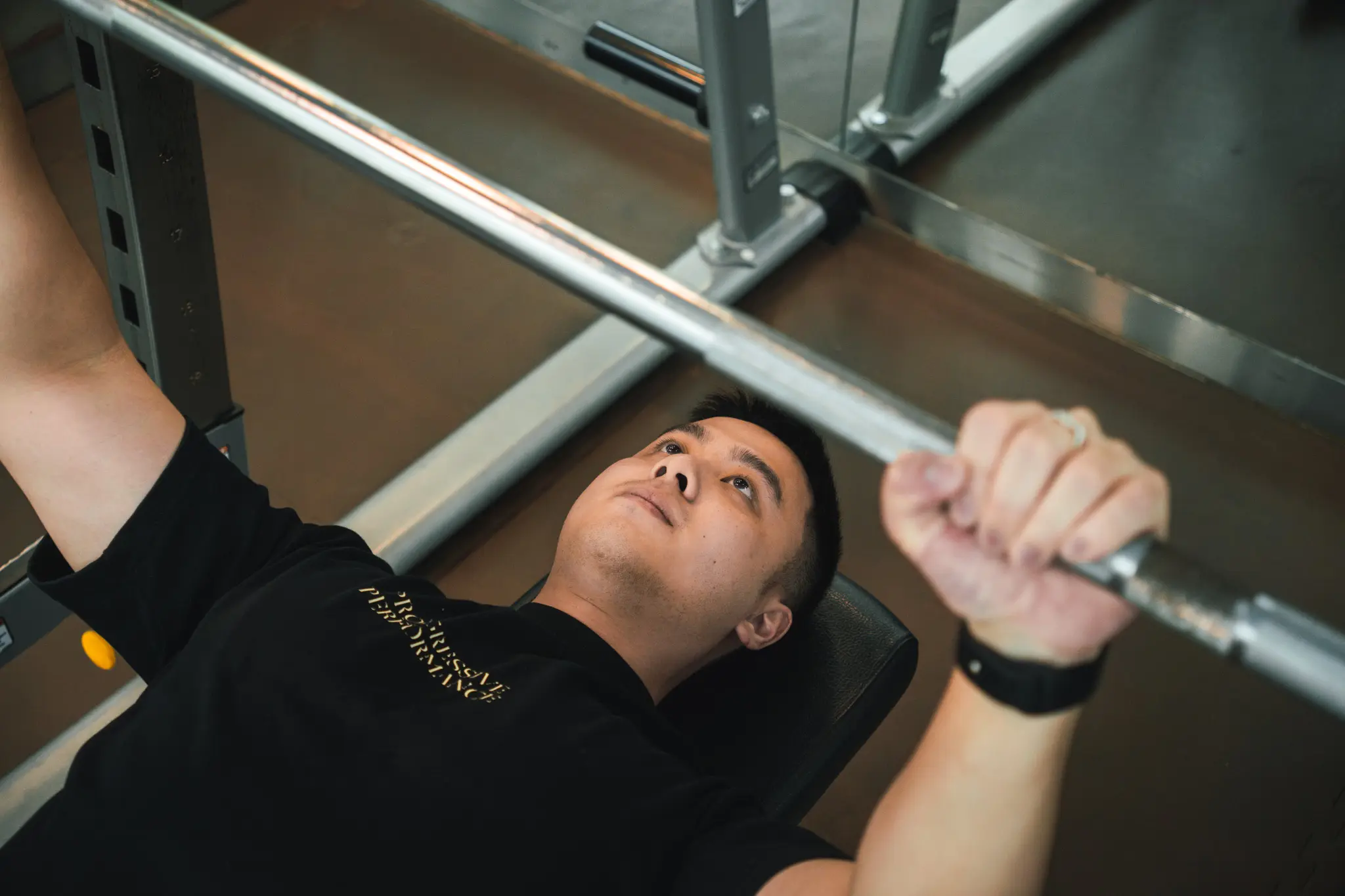


Consider increasing a weight when you meet your programme’s progression target across all planned sets, with the intended technique and effort. Then check whether the heavier weight still lets you complete the planned work. A successful first set alone gives you an incomplete answer.
If you fit training around meetings or a commute in Singapore, it helps to decide your next step from the session you recorded. You can keep building repetitions, try a manageable increase or adjust a weight that proved too demanding.
This guide assumes you already have a suitable exercise and working weight. If you are choosing those for the first time, start with our starting-weight guide.
Check what you are comparing
Compare the same exercise, equipment and setup. Keep the planned rest and movement consistent, and note how hard the sets felt. Twelve repetitions on a different machine cannot tell you exactly how much stronger you have become.
Record every working set. An entry of “12, 9” tells you more than recording only your best set. Our training-log guide explains what to record without turning your session into paperwork.
If a meeting left you rushing between sets, note that too. Return to the planned rest between sets before treating the next session as a clean comparison.
Choose between increasing, keeping, reducing or asking
The table below is a practical coaching framework for a programme that builds repetitions before increasing weight. Your coach may use different progression criteria. The table itself is not a research-tested formula.
| What happened across the exercise | Your next step |
|---|---|
| Every planned set met the agreed progression target, with consistent movement and the intended effort. | Consider a manageable increase at the next appropriate session. Check performance again at that weight. |
| Sets stayed within the planned range, but some fell short of the progression target. | Keep the weight and build repetitions within the programme. |
| A heavier weight took you below the planned minimum, or you had to change the agreed movement to continue. | Stop that set, return to a manageable load and reassess the remaining work. |
| The next equipment increment is too large, the exercise is unfamiliar, or progress has repeatedly stalled. | Ask your coach to review the exercise and progression options. |
You do not need to prove readiness by attempting a repetition you cannot finish. ACSM’s 2026 guidance supports individualising training and reports that reaching momentary muscle failure did not consistently improve outcomes for the average healthy adult. Effort still matters; agree what the end of each set should feel like.
An example that counts both sets
Suppose your coach has set two working sets of a familiar seated cable row, with 8–12 repetitions per set and some effort left at the end. You have agreed to consider an increase after completing both sets at 12 with consistent movement and the intended effort.
These numbers illustrate the decision. They are not a universal prescription or a record of the person in the photograph.
| Recorded sets | Decision in this example |
|---|---|
| Current weight: 12 repetitions, then 9. | Keep the weight. The second set has room to progress. |
| Current weight: 12, then 12, with the agreed movement and effort. | Consider the next manageable increment. Both sets meet the target. |
| After increasing: 9, then 8, with movement and effort still appropriate. | Keep the new weight and build within the range. Both sets still fit the plan. |
| After increasing: the first set reaches only 7 before the agreed movement changes. | Stop the set and reduce the weight before reassessing. Do not force a second set at that load. |
The two “after increasing” rows are alternative outcomes. They are not instructions to attempt both, and there is no fixed number of sessions between these steps.
When the increase does not work
Write down what happened before changing the plan. Was the available jump larger than expected? Did you shorten your rest, change equipment or struggle to repeat the setup?
For the example above, return to a load that lets you perform the remaining planned work appropriately. Avoid repeatedly testing the heavier setting that session. If the available increments are awkward, your coach can review another suitable progression or piece of equipment.
Adding repetitions is a legitimate progression option. A 2024 study by Chaves and colleagues followed 39 previously untrained young adults for ten weeks. Each participant’s legs used different progression methods: increasing load or increasing repetitions. Both methods improved leg-extension strength and measured thigh-muscle size, with no statistically detected difference between them.
That short study does not establish identical long-term results for every exercise or validate the example above. It supports considering repetitions alongside weight when planning progression.
If you have returned after time away, or several comparable sessions remain difficult, review the programme with your coach. Stop exercising if you experience pain or become unwell, and seek appropriate professional advice.
Get help deciding your next training weight
Progressive Performance’s one-to-one personal training includes personalised programming, technique guidance and progress reviews. Discuss your training with the team, including the exercise you are working on and what happened across your recent sets.
Sources
- American College of Sports Medicine. 2026 resistance-training guidelines update. 17 March 2026. Its current position stand is Resistance Training Prescription for Muscle Function, Hypertrophy, and Physical Performance in Healthy Adults: An Overview of Reviews, published online 5 March 2026. DOI: 10.1249/MSS.0000000000003897.
- Chaves TS and colleagues. Effects of Resistance Training Overload Progression Protocols on Strength and Muscle Mass. Published online 29 January 2024; International Journal of Sports Medicine, 45(7):504–510. DOI: 10.1055/a-2256-5857. Findings checked against the original abstract.