
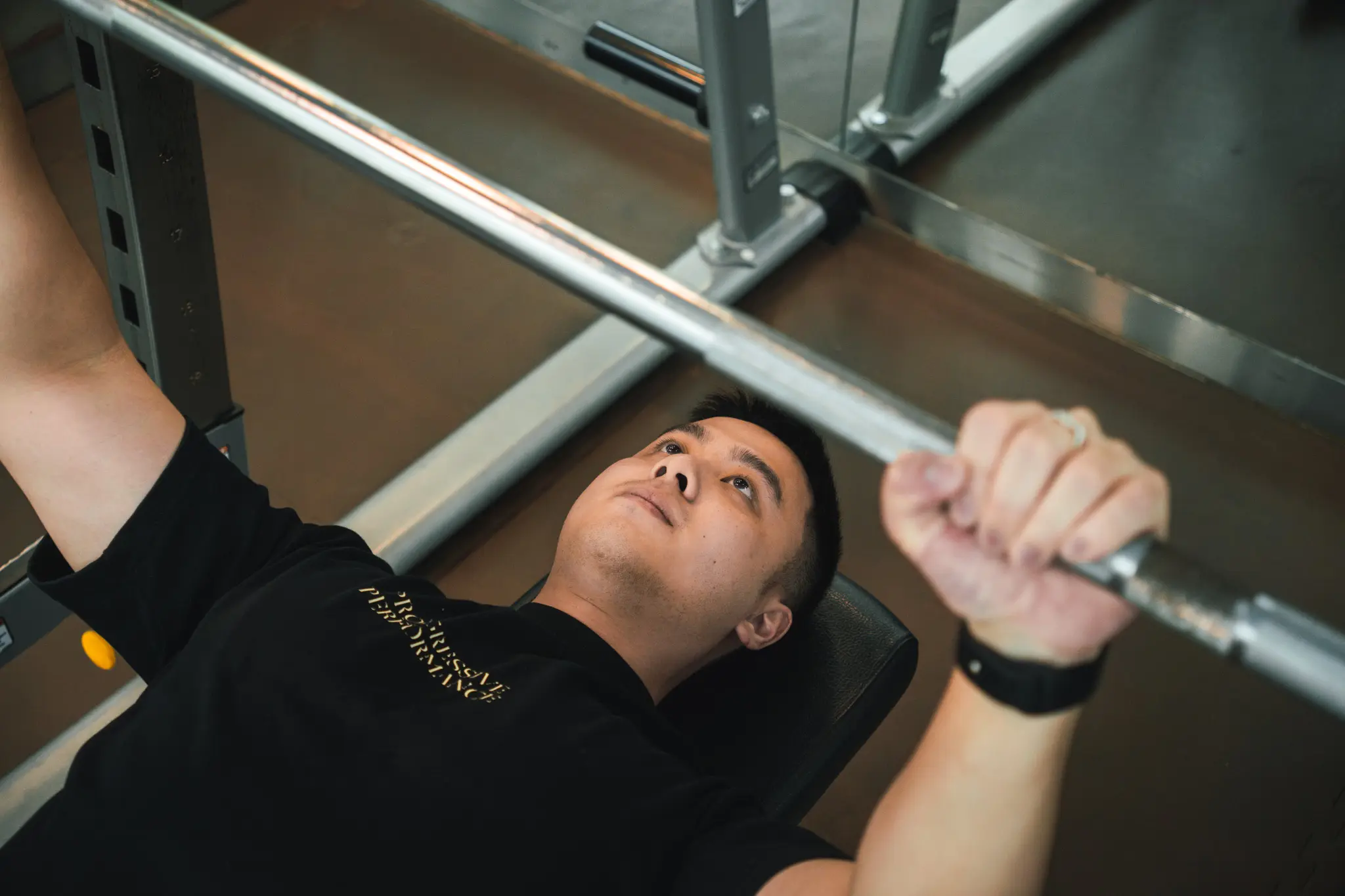


You do not need to take every strength-training set to failure to make progress. Agree how hard the set should be, keep the intended movement consistent, and stop when you reach that point or can no longer maintain the agreed technique.
That can feel less obvious halfway through a demanding set. Your breathing is heavier, the weight feels slower, and you wonder whether stopping now means you have held back too much. If you train around a busy Singapore workday, having a clear stopping decision helps you use the session you have planned.
What training to failure means
Momentary muscular failure means you attempt a repetition but cannot complete its lifting portion through the agreed range with the intended technique. It is more specific than a set feeling difficult.
You can also stop because your technique starts to change. On a seated row, for example, you might begin swinging your torso to move the handle. Ending the set there does not establish that the intended muscles reached failure. It tells you that the movement no longer met your agreed standard.
Set that standard before lifting: where the movement starts and finishes, how your body is supported, and how you will return the weight. A planned stopping point should never require you to force an unsuccessful repetition.
Does every hard set need to reach failure?
ACSM’s 2026 position stand concludes that training to failure is not obligatory. It also acknowledges insufficient evidence to prescribe exact repetitions-in-reserve targets. Effort matters, but one number cannot settle the question for every person and programme.
In an eight-week study of 18 trained adults, each participant trained one leg to failure and the other with an estimated two repetitions left on leg presses and one on leg extensions. Average quadriceps thickness increased similarly. Failure produced greater losses in lifting speed and repetitions.
That supports stopping close to failure in that particular programme. It does not prove identical results across all exercises or show that failure never has a useful role. Your coach can choose effort alongside the exercise, training goal and remaining work.
Estimate the repetitions you have left
Repetitions in reserve, or RIR, is your estimate of how many additional full repetitions you could complete with the same weight, setup and movement standard. Two RIR means you think you could manage about two more. Extra repetitions made possible by swinging or shortening the movement do not count towards that estimate.
Treat the number as an estimate. A 2023 study involving 58 adults found that predictions during curls, pushdowns and seated rows were more accurate closer to failure and in later sets. Training experience did not significantly explain accuracy in that study.
If you are learning an exercise, “several left” or “unsure” may describe your experience more honestly than a precise score. Tell your coach what you felt and what changed. Practise the agreed movement and review your estimates together; deliberately failing repetitions is not a prerequisite for this conversation.
Make the stopping decision during the set
Suppose you and your coach agree to end a familiar seated-row set with roughly two good repetitions left, within your planned repetition range. This is an illustrative coaching agreement, not a universal target. These are alternative situations you might encounter.
| What you notice | What to do in this example |
|---|---|
| Your breathing is heavier, but you estimate several clean repetitions remain. | If you feel well and remain within the plan, continue with the agreed movement. Breathing alone does not establish muscular failure. |
| You estimate about two good repetitions remain and your movement is consistent. | End the set at the agreed effort. You do not need to attempt those extra repetitions to validate the stop. |
| You begin swinging your torso or shortening the movement to continue. | Stop the set and tell your coach what changed. Record the technique limit even if your RIR estimate is uncertain. |
| You experience pain or feel unwell. | Stop exercising and seek appropriate advice. Do not use an effort target as a reason to push through. |
Record why you stopped
After the set, separate your effort estimate from the reason you stopped. For this example, a useful note might read: “10 repetitions; about 2 RIR; stopped at the agreed effort.” Another might read: “8 repetitions; RIR unsure; torso started swinging.” These are illustrative entries, not client results.
The second entry gives your coach something concrete to review. Discuss whether the setup, load or rest needs attention before repeating the exercise. Our training-log guide explains how to keep those notes brief.
Allow the planned rest between sets before reassessing. If this discussion reveals that your initial load needs reviewing, use our starting-weight guide.
Get help judging effort in your own training
Progressive Performance’s one-to-one personal training includes personalised programming and technique guidance. Bring the exercise you are unsure about and describe why you usually stop. Discuss your training with the team to work through those decisions with a coach.
Sources
- ACSM position stand: Resistance Training Prescription for Muscle Function, Hypertrophy, and Physical Performance in Healthy Adults. Published 5 March 2026.
- Refalo and colleagues: failure versus repetitions in reserve and quadriceps growth. Published online 23 February 2024.
- Remmert and colleagues: accuracy of predicted repetitions in reserve. Published online 10 April 2023.